
Former Hughes Jail Release Route
The courthouse-basement jail closed in November 2023. It is therefore a routing point, not a place where a person can now be released. Call the verified Hughes County Sheriff’s Office listing and ask which physical jail accepted the named person. The first documented move after closure sent detainees to Seminole County Jail. Later reporting identified at least one Hughes detainee at Okfuskee County Jail under an inter-county arrangement. Those facts show that placement can change. They do not make either neighboring jail the permanent destination for every arrest.
A person can leave a receiving jail in several ways. Bond, a dismissal, time served, or sentence completion can result in a community release after staff clear all other holds. Transfer to another county, ODOC, the U.S. Marshals Service, ICE, or a tribal authority ends one jail stay but continues custody. Ask for the stated release manner and destination. A missing roster entry alone cannot distinguish those outcomes.
Confirm Former Hughes Jail Release
Use a two-record method. The physical jail record establishes when and how staff ended that custodial episode. The Hughes court record shows the order, bond event, dismissal, judgment, or sentence that supplied legal authority. Neither record always answers both questions by itself. A court minute may precede the actual exit because the jail must still verify identity, process property, and check other holds.
- Give HCSO the full name, date of birth, approximate arrest date, and arresting agency if known. Ask which jail took custody.
- Contact that jail. Ask whether the person remains there, left for the community, or moved to another custodian.
- Request the booking and release entry, exact release date and time, release manner, authorizing order, and transfer destination when applicable.
- Search the official OSCN docket with Hughes County selected. Compare the case event with the jail’s physical-exit record.
- If ODOC received the person, use the state offender search and ODOC records. A prison location means continued confinement, not release.
Oklahoma VINE can add an agency-fed custody event or future alert. It is useful when a person moves between a county jail and ODOC. Yet a VINE status is not a certified release sheet. Confirm it with the agency named in the result. The broader Hughes County released-inmate search and record path explains how the court, jail, ODOC, and VINE records fit together.
Note: Save the date of each search because roster status, court events, and custody feeds can update at different times.
Former Hughes Jail Release Record
Oklahoma’s jail-register provision, 51 O.S. § 24A.8(A)(8), identifies maintained public information that includes a person’s commitment date and cause or authority, plus the date or manner of discharge or escape. A narrow request is more useful than a demand for a full inmate file. Ask HCSO and the receiving jail because the arresting agency, sheriff, contract jail, and court may each keep a different part of the event.
| Requested field | What it can show |
|---|---|
| Name, identifiers, booking number | Which booking episode the record describes |
| Commitment date and authority | When and why the custodian accepted the person |
| Release date and time | When that jail’s custody physically ended |
| Release manner or type | Bond, time served, dismissal, sentence completion, or another recorded outcome |
| Destination or receiving agency | Whether the event was a transfer rather than community release |
| Court or order reference | The legal authority linked to the exit |
No Hughes-specific online retention window, fixed fee, response deadline, request email, or web form was verified. Call first for the current method and an advance fee estimate. Ask for electronic copies and for the legal basis of any withheld field. A booking photograph should be requested only “if kept and not exempt,” because the jail-register statute does not list the photograph by name.
Former Hughes Jail Records Contact
The sheriff is the best confirmed starting contact. It can identify the receiving jail and clarify whether HCSO keeps the local agency record. It may not own the physical release log created in another county. The current directory supplies no published records hours, fee chart, or online release archive, so call before visiting or mailing a request.
Hughes County Sheriff’s Office
200 N. Broadway, Suite 1
Holdenville, OK 74848
Phone: 405-379-2203
Hours: Call first; public records hours were not verified.
For the legal order or judgment, contact the Hughes County Court Clerk at P.O. Box 32, Holdenville, OK 74848, 405-379-3384. Request a certified copy when proof of the court action matters. The clerk does not replace the receiving jail’s record of the time staff carried out the release.
Former Hughes Jail Closure Record
The former jail was designed for 36 people. Reporting documented seven failed inspections since 2019 and 454 people detained during 2022. The latter figure is annual throughput, not a one-day population and not a count of confirmed releases. The KGOU and Oklahoma Watch closure history supplies the facility context.
The source image below shows that reporting. It does not identify whether any named person was released.
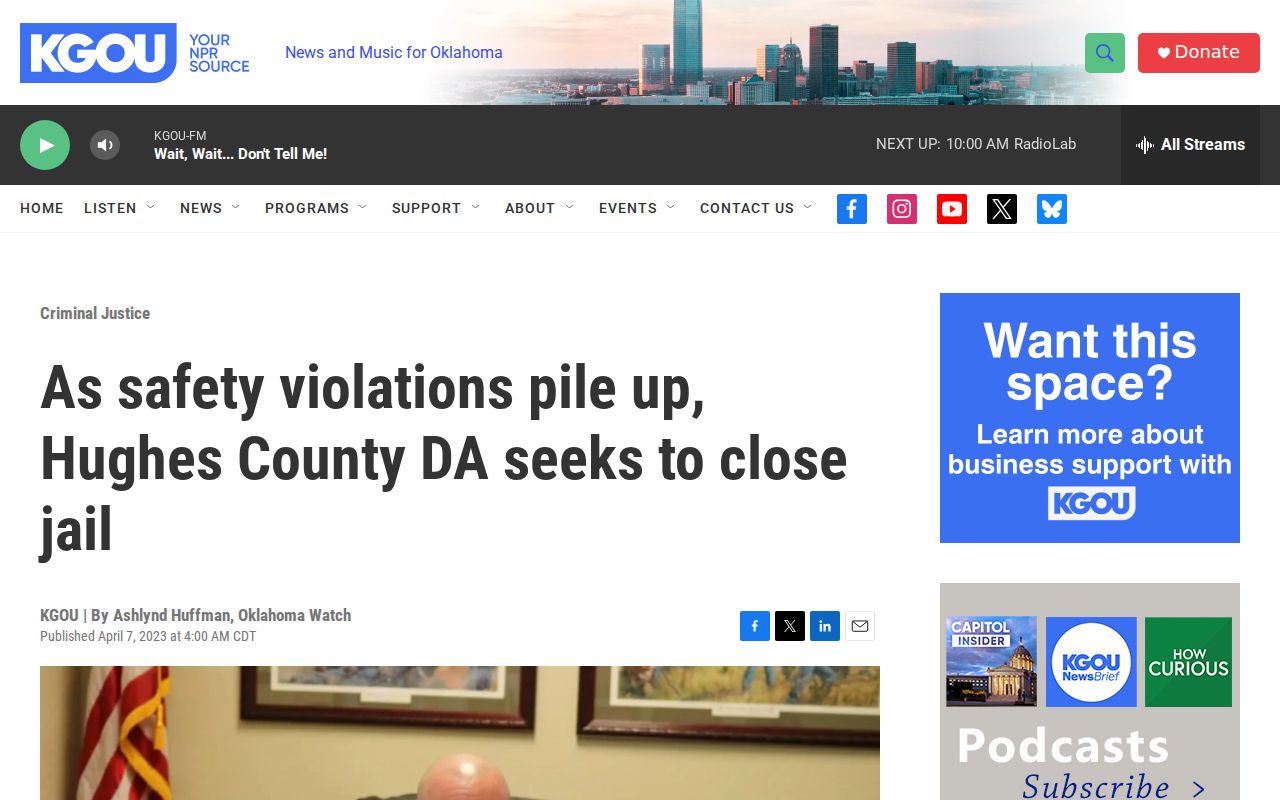
The closed facility’s history explains why a search for a present-day Hughes jail roster fails. It also explains why contact with the sheriff must come before a receiving-jail lookup.
The Oklahoma State Department of Health jail program describes annual inspection authority and admission and release standards for city and county jails. Inspection records show facility conditions and compliance. They are not person-level release records.
Hughes Release Systems Split
Two different custody changes happened in 2023. Hughes County closed its local basement jail and began holding local detainees elsewhere. Separately, ODOC took over Davis Correctional Facility in Holdenville and renamed it Allen Gamble Correctional Center. AGCC did not close with the county jail. It remains a state prison for men.
This distinction controls the search route. A Hughes arrest held under a contract arrangement calls for HCSO, the receiving jail, and the Hughes court file. A person at AGCC is in ODOC custody and must be checked through ODOC Offender Lookup, VINE, and ODOC discharge records. A new ODOC prison location is a transfer. Parole or community supervision may mean release from prison walls while state authority continues. Discharge is the formal end of the state sentence or supervision reflected in the proper ODOC record.
Note: “Hughes County inmate” can describe a local detainee housed elsewhere or an ODOC prisoner held in Holdenville.
Hughes Transfers Are Not Releases
Hughes County has a documented tribal-jurisdiction layer. A DOJ-hosted cross-deputization agreement shows how BIA, Muscogee, and Hughes authorities divided certain duties. Its detention terms are historical because they refer to the now-closed county jail. They should not be used as a current routing map.
The agreement still teaches an important records point. The arresting officer, transporting agency, prosecuting court, and physical custodian may be different public bodies. If a receiving jail says it transferred the person to a tribal or federal authority, ask for the destination and transfer time. Then verify with that authority. Never rewrite the transfer as release merely because the person vanished from a local roster.
Former Hughes Release Terms
Keep the agency’s exact term. Bond ends physical detention in that episode while the case continues. Time served means the credited custodial term in that case ended. A dismissal may remove one legal basis but leave another hold. Parole moves an ODOC prisoner into conditional community supervision. Probation is court-ordered supervision tied to the judgment. None of those terms should be replaced with a vague “out.”
- Community release
- The person leaves that custodian without a documented handoff to another custodial agency.
- Transfer
- Custody continues under another jail, prison, tribal, federal, or immigration authority.
- Discharge
- The formal end of a sentence or supervision term shown by the responsible authority.
- Detainer
- A request or notice that another agency may take custody after the present hold ends.
When records conflict, obtain the signed court order and the release or transfer entry from the agency that executed the physical exit. That pairing gives both legal cause and custodial fact.
Search Former Hughes Release Records
Historical confirmation often begins after every live roster clue has expired. Ask whether HCSO or the receiving jail can search an archived jail register, booking sheet, dispatch entry, transport log, or contract-custody invoice for the relevant date. Give the full name, birth date or booking number, approximate arrest date, and arresting agency. Request electronic copies, an advance fee estimate, and the legal basis for any withheld field. A referral to another custodian is useful because it identifies who created the missing part of the custody trail.
Name matching needs care. Compare aliases, date of birth, Hughes case number, booking number, and ODOC number when available. Do not merge two people because their names look alike. An OSCN no-match is not conclusive because spelling, filing status, or a lawful seal can affect public visibility. A VINE no-result can also reflect lag, transfer, or coverage limits. Use each source only for the question it can answer.
Federal routes have their own boundaries. BOP Locator is suited to sentenced federal custody and may show a past federal release date. A federal pretrial detainee can remain under USMS authority in a local contract bed without appearing as a sentenced BOP prisoner. ICE uses a separate locator for current and some recent immigration detention. None replaces the former Hughes booking and transfer record.