
AGCC Offender Release Routes
Allen Gamble Correctional Center is part of the Oklahoma Department of Corrections. It is not the former Hughes County Jail. A person leaving AGCC may discharge the sentence, enter parole under ODOC supervision, move to a lawful community placement, or transfer to another ODOC institution. A new prison location means continued confinement. A community or supervision status may show release from prison walls while state authority remains.
Start with the ODOC Offender Lookup. Compare the full name, aliases, date of birth, ODOC number, photo, sentencing county, offense rows, reception or sentence dates, and current status or location. Do not assume that a Hughes County conviction is required. AGCC holds state prisoners whose cases can come from anywhere in Oklahoma.
Confirm an AGCC Release
ODOC’s public lookup is abbreviated and carries an accuracy warning. It is a strong starting point, not always the final document. A former-offender or discharged status can support state-system exit. A parole or probation label indicates community supervision may still be active. If exact legal proof is needed, request the public discharge record from ODOC Offender Records.
- Search by name and ODOC number when available. Open only a record whose identifiers match.
- Read the current status and location. A prison name means custody continues, even if AGCC no longer appears.
- Review offense, sentencing-county, and sentence rows to ensure the record belongs to the right person.
- Check Oklahoma VINE for an agency-fed release or transfer event and save the check date.
- Ask ODOC for the public release or discharge status, date, and type maintained in its records.
- If parole appears, verify supervision through the ODOC probation and parole office, not the sheriff.
The public result may show a Projected Release Date, or PRD. It is an estimate, not the actual exit record. ODOC also states that precise release dates may be confidential without a legitimate need and that projected dates can change. Describe only the field visible on the live result. Never calculate a substitute date.
AGCC Release Search Fields
ODOC records use state-sentence fields, not county booking-sheet fields. Their meaning must remain separate. A reception date marks entry into the state system. A projected date is tentative. A parole decision is not the prison door-exit time. Discharge is the formal end of the state term reflected by the proper record.
| ODOC field or record | How to read it |
|---|---|
| ODOC number and identifiers | Confirm the correct person across state records |
| Status and location | Shows prison, community-supervision, or historical state status |
| Offense and sentencing county | Connects the state term to the controlling case |
| Projected Release Date | A tentative estimate when the live public result displays it |
| VINE event | An agency-fed custody change that needs record confirmation |
| Discharge response | Stronger documentation of the public ODOC release or discharge event |
A favorable Pardon and Parole Board result is another distinct event. It records the Board’s action or recommendation. Some cases require further action. Even a final favorable decision does not supply the exact physical release time. Confirm status with ODOC, VINE, and the discharge record.
Note: Parole eligibility, a Board docket, a favorable result, physical release, and final discharge are five different milestones.
AGCC Release Records Contact
AGCC can answer facility-specific routing questions. Public offender and discharge records belong through ODOC channels. ODOC Legal Services provides the state open-records route, while Offender Records handles closed-record and discharge inquiries subject to privacy limits.
Allen Gamble Correctional Center
6888 E. 133rd Road
Holdenville, OK 74848
Phone: 405-698-5900
Operator: Oklahoma Department of Corrections
ODOC Records Routes
Legal Services: 405-425-2515
Offender Records: 405-425-2691
Discharge-only email: osordischarges@doc.ok.gov
Central office: 405-425-2500
Use the ODOC Legal Services request page for the current form. Supply the person’s name, birth date, ODOC number, date range, and exact public fields sought. No fixed public fee or discharged-file retention period was verified, so request a quote and the current record schedule.
AGCC Prison Facts and Status
The official fact sheet describes AGCC as a 1,723-bed prison for men. ODOC took operations from CoreCivic and renamed Davis Correctional Facility effective October 1, 2023. In April 2026, ODOC announced that former maximum-security beds at AGCC were converted to medium after assignment changes. A security-level or housing assignment change does not release anyone.
The facts establish facility type and scale. They do not supply a release list. For a named person, return to the state search, VINE, and ODOC records rather than treating a facility update as custody proof.
AGCC Takeover and Release Records
The ODOC takeover announcement documents the state’s change in operation. The manifest capture appears below.
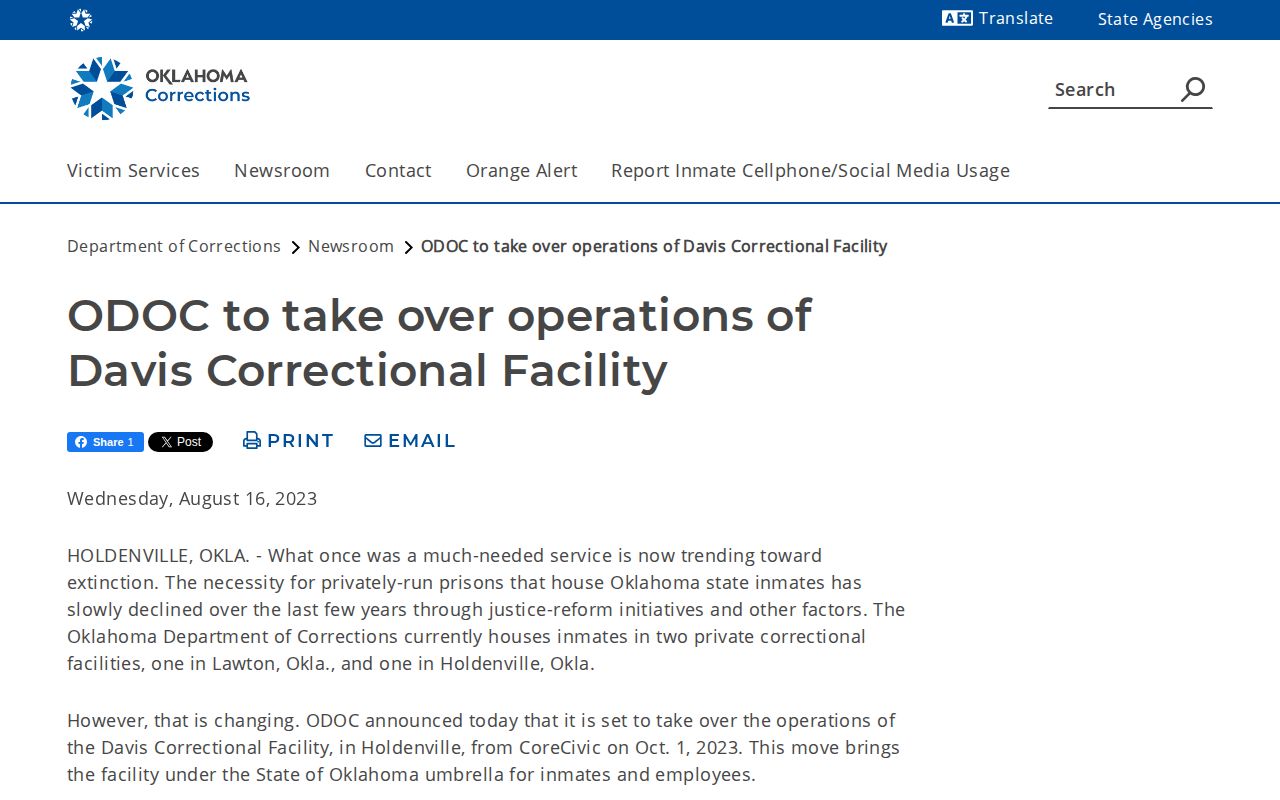
The capture helps match older Davis references to current ODOC records. It does not show a person’s release.
The official renaming announcement explains the Allen Gamble name.
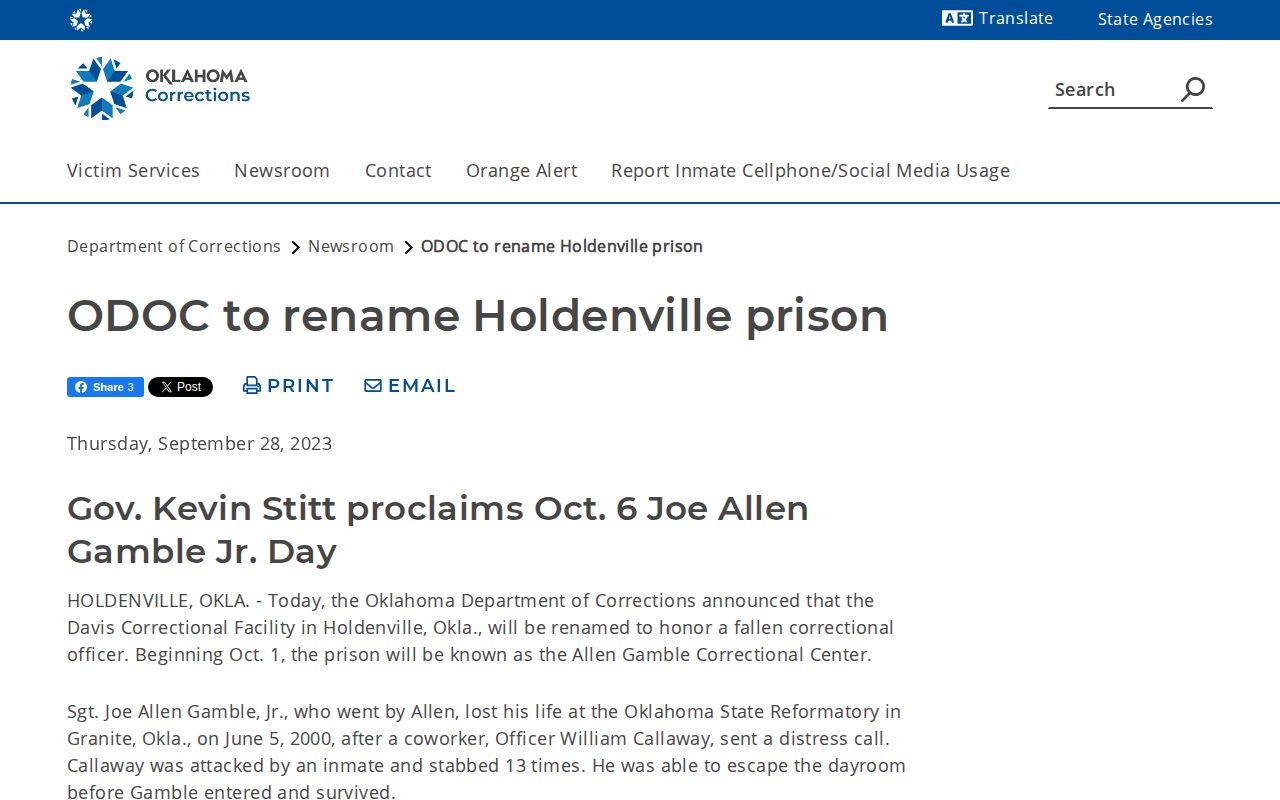
Searchers with an older record may see Davis Correctional Facility. The name change did not end custody or create a mass release event.
AGCC and Hughes Jail Differ
Two local custody stories unfolded in 2023. Hughes County closed its troubled courthouse-basement jail and began routing local detainees out of county. ODOC separately took over and renamed the large state prison in Holdenville. AGCC did not close with the county jail. Confusing the two sends a search to the wrong records system.
A local Hughes detainee may be physically released by a receiving county jail, with the Hughes court supplying legal cause. An AGCC prisoner leaves through ODOC authority. The ODOC record may show transfer, parole, community status, or discharge. The Hughes County custody and release search helps distinguish these paths when the last system is uncertain.
AGCC Transfers Are Not Releases
The historical Hughes/BIA/Muscogee cross-deputization agreement illustrates why arresting, prosecuting, transporting, and custodial agencies can differ. Its detention provisions predate the county jail closure and do not govern AGCC releases. AGCC is controlled by ODOC records and state sentence authority. The agreement cannot be used to predict where an ODOC prisoner will move.
A transfer from AGCC to another prison remains ODOC confinement. A transfer to a mental-health facility or another lawful custodian also should not be relabeled as community release. VINE coverage can change during some transfers, so an alert gap is not proof of discharge. Ask ODOC for the destination and current status. If the transfer crosses systems, keep both agencies’ event dates and confirm which one retains legal custody.
- Transfer
- Movement between custodians while confinement continues.
- Parole
- Conditional community release with ODOC supervision.
- Projected release
- A tentative estimate that can change.
- Discharge
- The formal end of the ODOC sentence or supervision term shown by the state record.
Verify Older AGCC Discharge Records
A former AGCC prisoner may remain in ODOC’s historical lookup even after the prison stay ends. Compare the ODOC number, aliases, birth information, photo, sentencing county, offense rows, and present status. A former-offender or discharged result supports state-system history, but the public portal is abbreviated. For durable proof, ask ODOC Offender Records for the public release or discharge status, date, and type it maintains.
Projected dates can move when earned credits, achievement credits, misconduct losses or restoration, consecutive sentences, corrected jail credit, or court action changes the computation. Parole eligibility is a different date. Being eligible, appearing on a Board docket, receiving a favorable result, leaving AGCC, and completing supervision are separate milestones. Check live status after each one rather than turning an old estimate into an actual release date.
Oklahoma VINE adds a useful custody-change layer. State material describes alerts for release, transfer, escape, apprehension, and death across county-jail and ODOC settings. Match the ODOC number and agency before relying on an alert, then obtain the state record. An alert gap or no-result does not prove discharge. If ODOC transferred the person outside the visible path, ask which agency retained legal custody and keep both event dates.
Resolve AGCC Release Conflicts
ODOC lookup status, VINE alerts, Parole Board material, and discharge responses can carry different dates because they document different events. A Board result may precede release. A VINE event may reflect an agency update. The discharge record may address the end of a state term rather than the day the person left AGCC. Label each date before comparing it.
If the lookup still names another prison, confinement continues after the AGCC transfer. If it shows parole or probation, prison custody may have ended while ODOC supervision remains. A discharged or closed historical status is stronger evidence of state-system exit, but request the official public record when exact proof matters. The Hughes Sheriff does not reconcile these state sentence records.